Wichita, KS · Garage Door Service
Derby homes built around 1990 run mostly steel raised-panel doors on extension springs. See what a repair or replace call actually costs here and why.
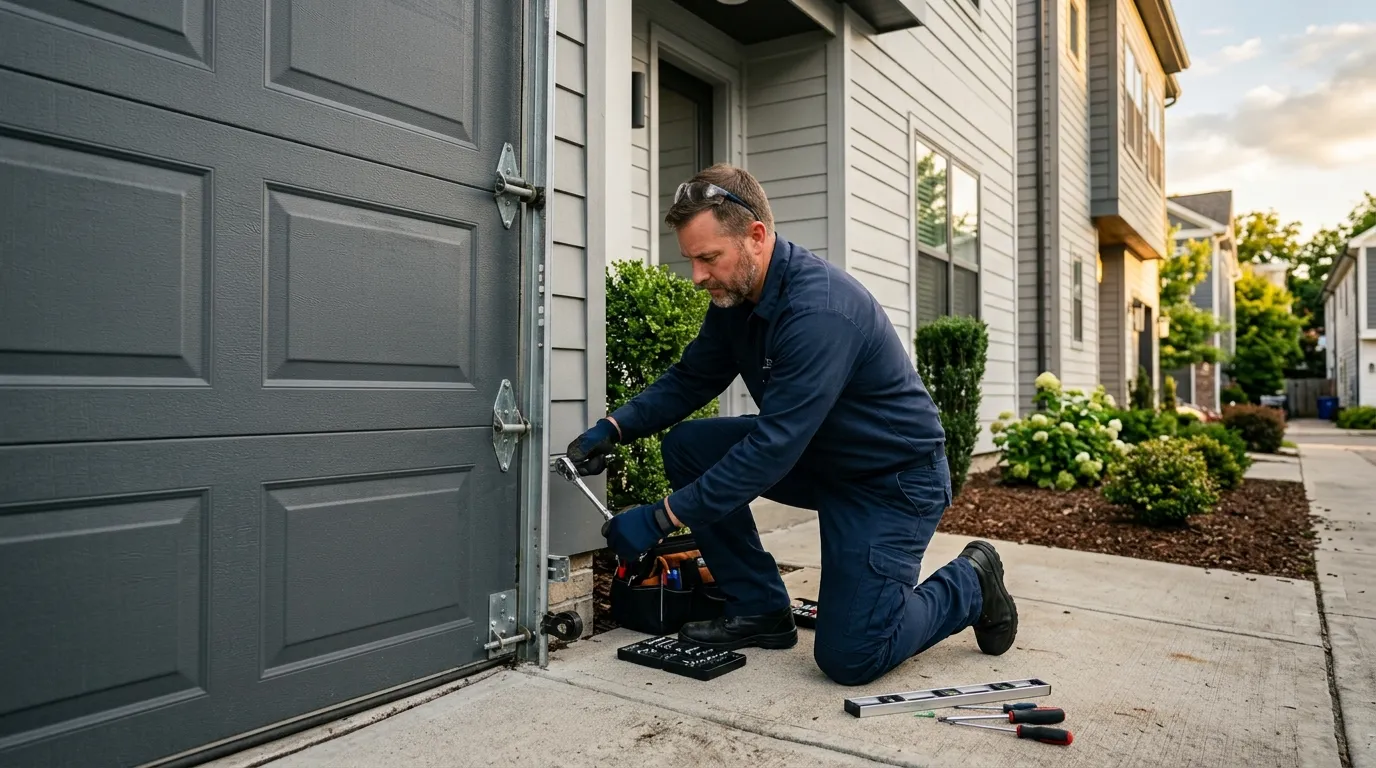
Derby's median household income sits at $82,089, which puts most of this town in a spot where a spring or opener repair almost always makes more sense than a full door swap. At that income level, a $1,500+ replacement door is a real budget decision, not an impulse buy, and it usually gets weighed against a $200-$400 spring or cable job first. Derby's housing stock is younger than a lot of the older core neighborhoods closer to Wichita - the median build year here is around 1990 - so you're not dealing with the oddball 1960s hardware that forces a full teardown. Most of what we see on these doors is standard 16x7 steel sectional panels on extension or torsion springs, the kind of setup where parts are still stocked and a repair holds up. That keeps the repair-vs-replace math simple: if the track is straight, the panels aren't rusted through, and the opener motor still turns, fixing it beats replacing it almost every time in this town. Where it flips is when the door itself is original to a house built right at that 1990 mark - by now some of those first-generation openers and springs are past a reasonable service life, and replacing the whole unit at once can cost less over time than a string of one-off repairs.
A house built around 1990 in Derby was framed to a different set of assumptions than one built in the 1960s or in the last decade. Insulation values were lighter, and a lot of these garages weren't finished with the door in mind - so the original door on many of these homes is a single-layer steel panel that's been carrying 30-plus years of Kansas temperature swings without much insulation to buffer it. In this climate band, that matters: cold snaps make steel contract, and a door that isn't dead square on its track starts binding right where the rollers meet the horizontal run. That's the failure we see most in this age of Derby home - not a snapped spring out of nowhere, but a door that's been quietly racking on its track for a year until the roller finally seizes or the cable jumps the drum. It's a slower failure than what you'd get on a much older door, but it's just as real, and it tends to show up as 'the door's noisy' long before it shows up as 'the door's stuck.'
A torsion spring under tension can put someone in the hospital, full stop - that's not a job for a Saturday with a socket set, regardless of what town you're in. But a lot of what goes wrong on a 1990s-era Derby door is smaller than that. Lubricating rollers and hinges, tightening loose bracket bolts, checking that the track is still plumb - those are reasonable DIY checks that can buy you time before you need a call. What you shouldn't touch: the spring itself, the cables, or anything where the door is under load. We'll also say plainly that not every noisy door needs a service call - sometimes it's just a dry roller, and a can of the right lubricant solves it for free.
We're based in Wichita and cover Derby from there - it's about a 10-mile run, so we're not sitting on the other side of town when a job comes up. There's no local branch or depot in Derby itself; the truck comes from Wichita for every call. Get in touch through the Derby repair page to describe what the door's doing, and we'll get a truck scheduled.
Given Derby's median income of $82,089, most repairs under a few hundred dollars are worth doing before you jump to a full replacement, especially since houses here average around 1990 construction with standard, still-available hardware. Replacement starts to make more sense once the opener, springs, and track are all failing at once rather than one at a time.
A lot of Derby's housing stock dates to around 1990, built with single-layer steel doors that weren't insulated to today's standard. In this climate's cold spells, the steel contracts and a door that's slightly out of square on its track starts binding at the rollers before it seizes outright.
No. We're based in Wichita and drive out to Derby for every job, about a 10-mile trip. There's no local depot here, just a truck dispatched from Wichita when you call.
Lubricate the rollers and hinges and check that mounting bolts are snug - those are safe DIY steps. Leave the spring and cables alone; they're under enough tension to cause serious injury and that's true no matter how the rest of the door looks.
Call or request a quote - tell us what your door is doing and where you are.
