Wichita, KS · Garage Door Service
Garage door repair for Haysville, KS homes built mostly in the late 1980s. We travel from Wichita, 9 miles out, and know the hardware this housing stock carries.
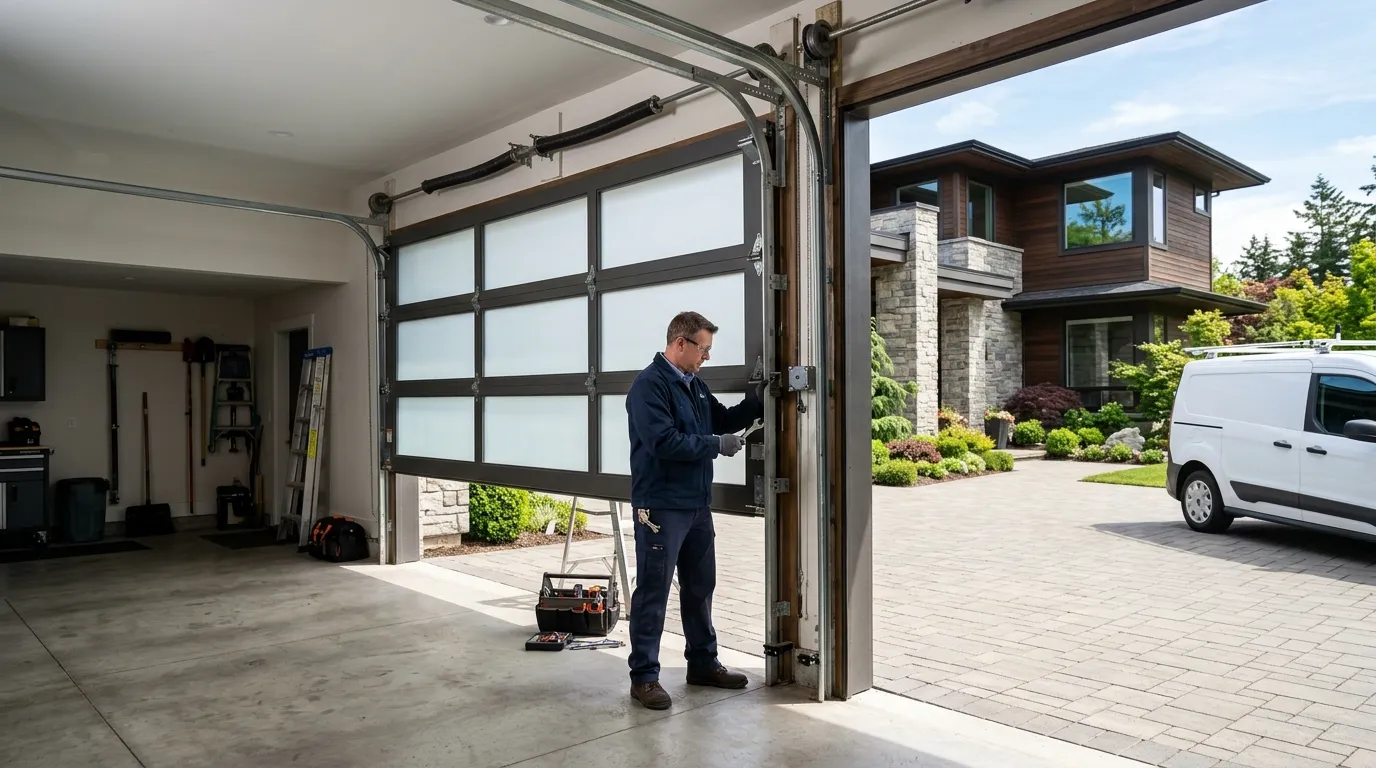
A torsion spring holding a couple hundred pounds of door is not a weekend project, and we'd rather tell you that up front than sell you a service call you don't need. If your door is heavy to lift by hand with the opener disconnected, or one cable looks slack while the other is taut, that's a spring problem and it stays in the garage until a tech gets there.
What you can check yourself: the photo-eye sensors near the floor track (wipe the lenses, make sure nothing's blocking the beam), the lock bar if the door won't budge at all, and whether the wall button or remote battery is dead before you assume the opener itself failed. On houses built around 1988, which is the median build year for homes in this area, we also see loose track brackets where the lag screws have worked out of aging jamb wood over three-plus decades. Tightening those is fine to try. Anything involving the spring, the cable drum, or the torsion bar itself is not a DIY repair - the failure mode there is sudden and it's the kind that breaks fingers, not just doors.
The call we get most from this side of the metro is a door that slams down the last foot instead of settling, or one that reverses partway up like something's fighting it. Both point to spring fatigue, not opener failure, even though the opener usually gets blamed first because it's the part making noise.
The reason this shows up so often here specifically: houses in this stretch cluster around a 1988 build year, meaning the original door and torsion hardware on a lot of these garages is now 35-plus years old. Springs are rated by cycle count, not calendar years, but a door that's been opened twice a day for three and a half decades is well past where most torsion springs are engineered to hold. When one side goes, the door doesn't fall evenly - it racks, and that's the slamming or fighting sensation homeowners describe on the phone.
Haysville's median household income runs about $69,057, noticeably below the roughly $82,000 median across the wider Wichita-area service territory. That number matters for one practical reason: a lot of these houses got their original builder-grade door and opener and never upgraded, because a working door doesn't get replaced on a budget that's stretched elsewhere first. So the hardware we find here skews older than what we see in some of the newer-build suburbs closer to Wichita.
Climate plays a role too. This area sits in the same cold-moderate band as the rest of the region, which means steel doors and springs go through a real seasonal contraction-and-expansion cycle every year, not the mild swings you'd get somewhere warmer. On a spring that's already fatigued from 30-plus years of cycles, a cold snap is often the thing that finishes it off - which is why we see a real uptick in torsion spring calls here through the coldest stretch of winter. It's not a different fault than anywhere else in the region; it's the same fault happening on older springs, in a climate that doesn't go easy on them.
We're based in Wichita and drive out to Haysville for repair calls - there's no local branch or drop-off counter here, just a truck that comes to your driveway. It's about nine miles from our shop, which keeps it a straightforward add to the day's route rather than a special trip, but we still ask that you call or book online rather than expect a same-hour walk-up.
Have the door's approximate age or the house's build era ready when you call - if you know it's original to the house and the house went up in the late '80s or early '90s, that alone tells us to bring the right torsion spring sizes rather than guess on-site. You can reach us through the Haysville repair page or the main Wichita repair page, whichever you landed on first; both route to the same scheduling.
We stock torsion springs in the sizes that match doors from the 1975-2011 build window, which covers the bulk of this area's housing including the 1988-median stretch that makes up most of Haysville. That means the common repair - one or both torsion springs, plus the cable and roller wear that tends to show up alongside a spring failure - usually gets done in one visit without a special order.
Where we run into a wait is openers and full door panels for houses that kept a genuinely original builder unit; some of those motor models and matching panel finishes aren't made anymore, and a replacement means a modern equivalent rather than an exact match. We'll tell you that on-site before we start, not after.
That's almost always a torsion spring that's lost tension, not the opener. The spring is supposed to carry most of the door's weight on the way down; when it's weak, the opener motor ends up dropping the door instead of lowering it, which shows up as a slam. It's common on original hardware from houses built in the late 1980s.
No. We're based in Wichita and drive out to Haysville for calls, about nine miles each way. There's no local counter or drop-off point here - book by phone or online and a truck comes to you.
Depends on the model. If it's from the same era as a lot of this area's housing stock - late 1980s to early 1990s - parts for the exact unit are often discontinued, so a repair can mean sourcing an equivalent part rather than an exact match. Sometimes replacement ends up cheaper than chasing obsolete parts.
Yes. This area sits in a cold-moderate climate band, and steel contracts in winter. A spring that's already fatigued from decades of cycles is more likely to fail during a cold stretch than in mild weather, which is why winter tends to bring more spring-failure calls than summer.
Call or request a quote - tell us what your door is doing and where you are.
