Wichita, KS · Garage Door Service
Garage door repair for Mulvane, KS homes built around 1981, serving original torsion springs, steel panels, and chain-drive openers 16 miles from Wichita.
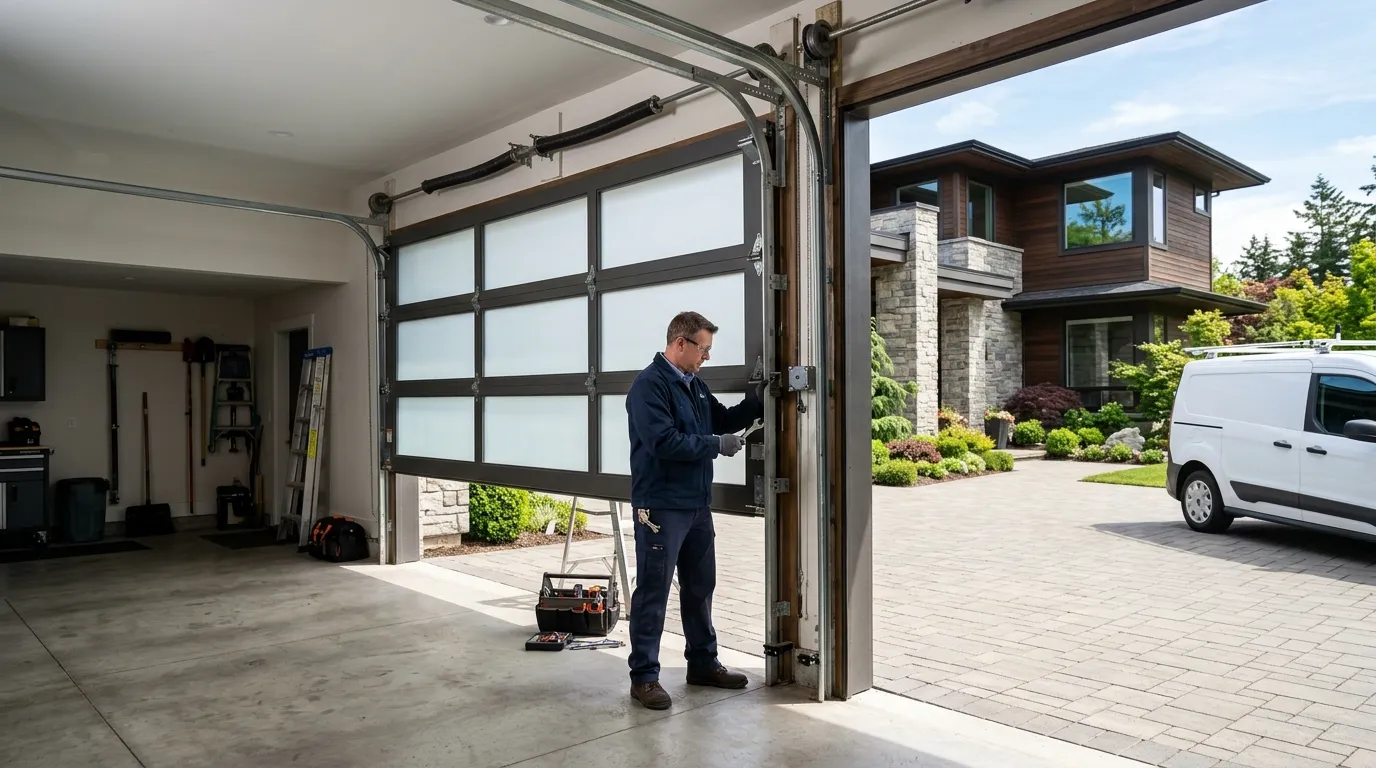
Mulvane sits 16 miles from our shop in Wichita, so the drive is part of every job here, not an afterthought. We don't quote a same-day window for this town because we're not staged nearby - we're coming from Wichita, and we tell you that up front rather than promise a number we can't hold to.
What we can control once we're on-site is the work itself. A torsion spring swap on a standard double door usually runs under two hours once the truck is parked and the door is up on the jacks. A full panel replacement on an original 1981-era steel door takes longer, mostly because non-standard section heights from that era aren't always a shelf part - we may need to order before we can finish the job in one visit.
If you call about a door that won't move at all, tell us that when you call. A spring that's snapped versus an opener that's dead are two different repairs with two different parts lists, and knowing which one it is before we load the truck saves a second trip out to Mulvane.
Mulvane's housing runs older than most of the towns we cover - the median year built here is 1981, a few years ahead of the 1988 median across the wider service area. That gap matters more than it sounds like it should. Doors from the early 1980s were built before the insulated steel sandwich panel became standard, so a lot of what's still hanging in Mulvane garages is a single-layer steel or wood-composite door on torsion hardware sized for a lighter panel than what eventually got hung on it during a later swap.
The failure that shows up most in a house this age is a spring rated for the wrong weight. Somewhere along the way the original door got replaced with a heavier one, and nobody re-rated the spring to match. It works fine for years, then one cold morning it doesn't.
County sits in a cold-moderate climate band, and the temperature swings that come with that are hard on old torsion springs and old steel tracks alike. Metal contracts, lubricant thickens, and a spring that was already borderline for the door's weight finally gives out.
For a broken torsion spring, we replace it with one rated to the actual weight of the door hanging on it now, not the weight of whatever door came with the house in 1981. That's the fix that keeps the same failure from happening again in a year.
If the door itself is the problem - warped, rusted through at the bottom panel, or just too heavy for the opener straining against it - we'll say so plainly instead of patching around it. On a door this old, replacement panels aren't always stocked locally, and matching an odd non-standard height from that era can mean a lead time before we can finish the swap. We'll tell you that cost and wait up front rather than let it surprise you mid-job.
Chain-drive openers from that same build era are another common call - worn sprockets, stripped gears, or a logic board that's finally quit after decades of Kansas heat and cold. Where the opener is original to the house, we replace it rather than chase parts for a unit that old.
The call we get most from Mulvane is a door that won't budge, full stop - not slow, not noisy, just stuck. That's usually the torsion spring, and on a house built around 1981 it's often the original spring, or a replacement that was never re-rated after a later door swap.
A close second is a door that opens but sags on one side or drops the last foot instead of closing flat. That points to a cable or a bottom bracket giving out, which shows up more on older steel doors where the original hardware has never been touched.
Opener trouble sounds different - a motor that runs but the door doesn't move, or a remote that stopped working with no visible reason. On a chain-drive unit from the early 1980s building boom in this area, that's frequently the drive gear stripped inside the housing, a wear part that just runs out after enough winters.
Mulvane has roughly 2,404 households, and median household income here runs about $70,224 - noticeably below the $82,000 median across the wider service area. That gap is worth naming honestly: it means replacement is a bigger decision here than in some of the other towns we cover, and we try to fix what can be fixed before we recommend swapping the whole door.
Parts availability is the other complication tied to the housing era. A door built to 1981 specs doesn't always match what's on the shelf today - section heights, track widths, and spring drums have all shifted slightly over four decades. When we can't match a part exactly, we'll say so and give you the honest choice between a close-enough repair and a full door replacement, rather than force a part that doesn't quite fit.
No. We're based in Wichita and drive out to Mulvane for calls, about 16 miles each way. We don't stage a truck locally, so we're upfront that we can't offer a guaranteed same-day window for this town the way we might for a stop closer to the shop.
Most Mulvane houses were built around 1981, before insulated steel doors were standard. If the original door was ever swapped for a heavier one without re-rating the spring, it runs fine for years and then fails all at once, usually on a cold morning when the metal has contracted.
Sometimes. Section heights and hardware sizing from the early 1980s don't always match what's stocked today. When we can't get an exact match, we'll tell you and lay out the choice between a close-fit repair and full replacement rather than force a part that doesn't belong.
Depends on what's failed and the door's age. If the panel is warped or rusted through on a door built to 1981 specs, patching around it usually costs more over time than replacing it outright. We'll give you a straight answer once we've seen the door, not a default upsell.
Call or request a quote - tell us what your door is doing and where you are.
