Wichita, KS · Garage Door Service
Valley Center homes run older than the Wichita area average, and at a $73,480 median income the repair-vs-replace call on an opener matters. We drive out from Wichita to fix it right.
Valley Center's median household income sits at $73,480, noticeably under the $82,000 median across the wider service area. That gap matters when an opener quits, because it changes where the line falls between fixing what's there and replacing the whole unit. A homeowner here is more often better served by a targeted repair - a new logic board, a new drive gear, a sensor eye that's gone bad - than by a blanket "just replace it" recommendation that makes more sense for a higher-income household that wants the latest features.
The housing stock adds to this. The median year built here is 1979, a full decade older than the 1988 median across the areas we cover. That decade shows up directly in the openers we find on service calls: more chain-drive units on aging rail, more control boards from before rolling-code security became standard, more units where the motor still runs fine but the logic that talks to the wall console or the remote has started to fail intermittently. That's a different repair than what you'd expect walking into a house built in the 2000s.
We come out from Wichita, about 10 miles away, so we're not guessing at this from a truck sheet - we see the pattern on real jobs in Valley Center.
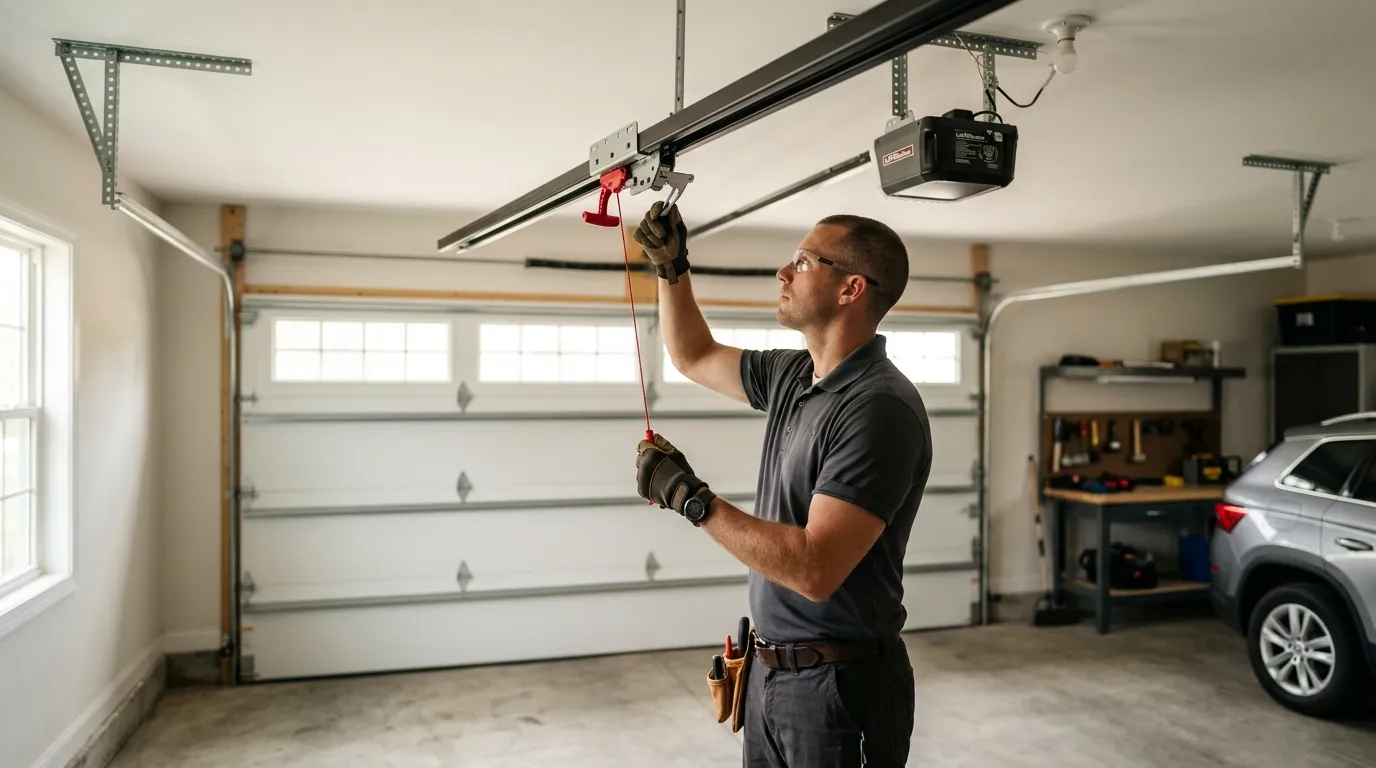
For opener work we stock the parts that actually fail: drive gears and sprockets for chain and belt units, logic boards, safety sensor pairs, trolley and carriage assemblies, wall consoles, and remotes. On a house from the late 1970s or early 1980s, the part that's usually gone is the logic board or the drive gear - the motor itself tends to outlast the electronics and the plastic drive components around it.
What we don't carry on the truck is anything specific to a discontinued opener model where the manufacturer has stopped making replacement boards altogether. That's rare, but it happens on units old enough, and when it does the honest answer is a new opener rather than a part we'd have to special-order and mark up. We'd rather tell you that on the phone than let you wait on a part that may not show up.
We carry the pieces that cover the wear points on the openers we actually see in Valley Center: gears, boards, sensors, and the wiring and hardware that connects them. If your unit needs something outside that list, we'll say so before we quote the job, not after.
Since we run out of Wichita and cover Valley Center as part of that territory, booking starts the same way it would for any job in this area - you tell us what the opener is doing (won't respond to the remote, runs but the door doesn't move, reverses for no reason, clicks but the light doesn't come on) and we get a truck scheduled. We don't keep a branch in Valley Center, so there's no local drop-in counter, but the 10-mile run from Wichita is a normal part of how we schedule the day.
Have the opener's age or brand handy if you know it, along with whether the door itself moves freely by hand with the opener disconnected - that tells us a lot before we even arrive. You can start that process through our Valley Center repair page, or if it turns out the issue is bigger than the opener itself, our Wichita opener repair page covers the broader service.
We start by separating the door from the opener - hand-operating it to confirm the door itself moves freely, since a heavy or misaligned door will burn out a perfectly good opener motor and get blamed for its own problem. Once we know the door's fine, we test the logic board, the sensor pair, and the drive train in that order, because that's usually the order failures show up in a house this age.
On a 1979-built home, we're often replacing a board or a sensor rather than the whole unit, and we'll tell you flat out when repair doesn't make sense - if the drive rail is bent, the motor bearings are shot, and the board is dead all at once, you're paying for parts on a unit that's done anyway. That's the one honest limitation worth saying up front: we don't stretch a repair past the point where it's still cheaper than a new opener. When it's not, we say so before we start charging for parts.
It depends what's actually failed. If it's the logic board or a sensor and the motor and drive train are sound, repair is usually the cheaper path. If the drive rail is bent or the motor is straining, you're better off putting that money toward a new unit instead of patching an opener that's failing on multiple fronts at once.
No. We run out of Wichita and cover Valley Center as part of the wider service area, about 10 miles out. There's no local counter or drop-in spot here - booking is scheduled the same way any Wichita-based job is scheduled.
Test it by disconnecting the opener and moving the door by hand. If the door is heavy, sticks, or won't move smoothly on its own, the door and hardware are the real problem, not the opener. We check this first on every call before touching the opener itself.
Valley Center's housing stock runs older on average - the median year built here is 1979, about a decade earlier than the broader area's 1988 median. That means more original chain-drive units and pre-rolling-code control boards still in service here than in newer-built neighborhoods.
Call or request a quote - tell us what your door is doing and where you are.
