Wichita, KS · Garage Door Service
Bel Aire homes mostly went up around 1995, later than much of the Wichita area. We travel out from Wichita to work on the torsion and opener setups that era left behind.
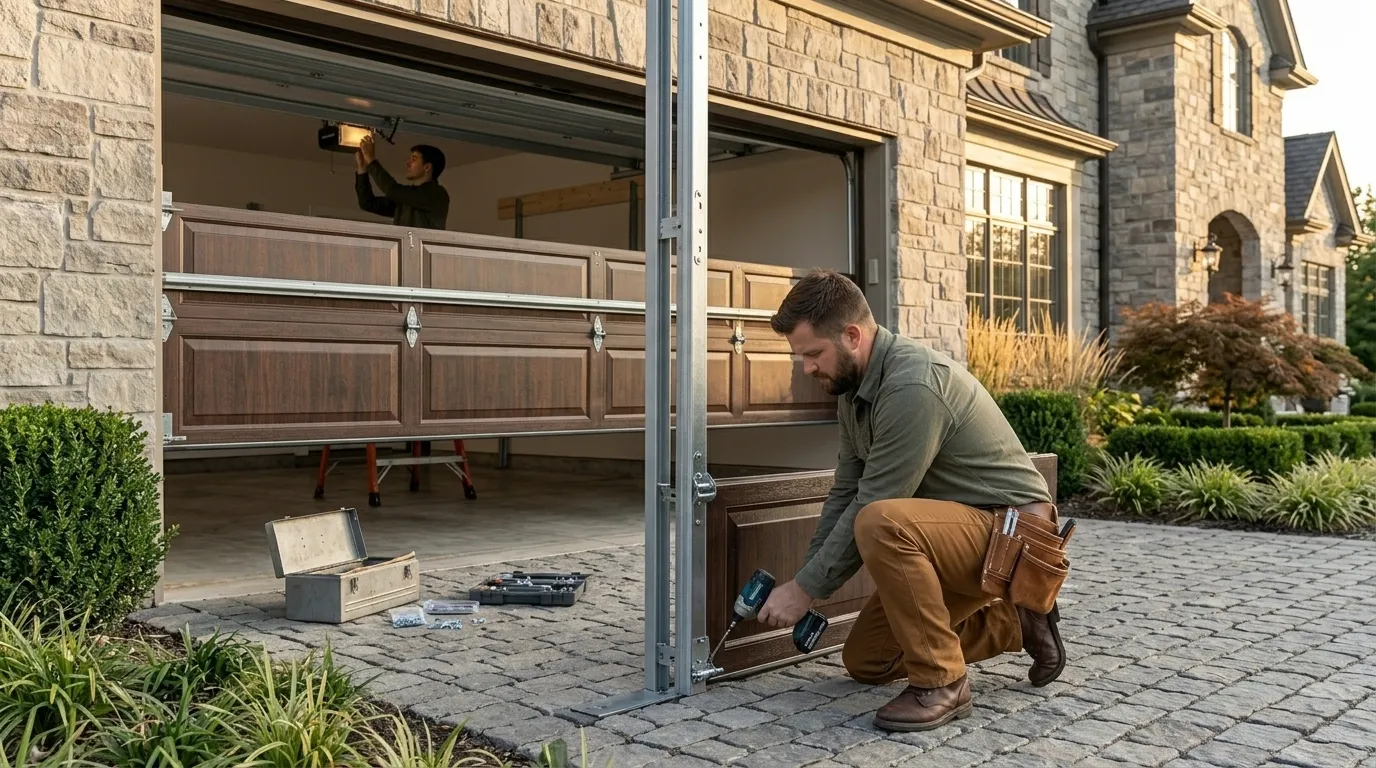
Bel Aire sits about 8 miles from our shop in Wichita, and the calls we get from out there follow a pattern tied to when the neighborhood was built. With a median build year around 1995, most of these houses came with torsion spring systems as standard rather than the older extension-spring setups you'd find in older parts of the metro. That means the failures we see are torsion-specific: a spring that's cycled 8,000-10,000 times and finally lets go, worn cable drums, or a center bearing that's dried out and started screaming on the way up. We also get a fair number of opener calls - chain-drive units from that build era are old enough now that the gearing wears out or the logic board starts failing intermittently, which is a different diagnosis than a dead spring. Panel dings and section replacement come up too, mostly from basketball hoops and backed-into corners, not from age. Because the housing here is more consistent in age than a lot of the older core of Wichita, our first guess on a service call tends to be right more often - we're not walking in blind on what decade of hardware we'll find.
We don't stock parts for pre-1980s extension-spring doors on the truck, since that's not what's common out here, so if a Bel Aire house has an older door than the neighborhood average, that job may need a return trip once we've got the right spring cone or track hardware. We also won't try to repair a torsion spring - it gets replaced, not patched, because a spring under that much tension isn't something you gamble on. And if a door has been hit hard enough to bend the track and rack the frame, we'll tell you straight that a full replacement is the better spend than chasing a bent-track repair that won't hold square for long. We're not a same-day-guaranteed operation for every call either - we run out of Wichita, so timing depends on the day's route.
Bel Aire's housing centers on a median build year of 1995, which puts it noticeably later than the broader service area's median of 1988 across the 1975-2011 range we work in. That decade-plus gap matters: a house built in 1995 has had roughly 30 years on its original hardware, which is right in the window where torsion springs (rated for a set number of cycles) start failing on their own, independent of any accident or misuse. With 3,076 households in Bel Aire and a median income of $93,182 - higher than the wider area's $82,000 - we also see more owners opting for full opener upgrades rather than patch repairs, replacing 1990s chain-drive units with newer belt-drive systems instead of just swapping a gear kit.
Because Bel Aire's stock leans newer and more uniform than much of the surrounding service area, the doors we're pulling off are almost always steel sectional doors on torsion hardware - not the wood or older aluminum panel doors you'd find in pre-1980s neighborhoods closer to the city core. That consistency cuts both ways. It means we can usually predict the spring wire size and drum setup before we arrive, which speeds up the visit. But it also means a lot of Bel Aire doors are hitting spring end-of-life around the same window, since they were installed within a few years of each other. In a cold-moderate climate like this one, temperature swings add stress to old springs and worn rollers faster than a mild climate would, so a spring that's marginal in October can snap outright on the first hard freeze. If your opener or springs date to the original 1995-era install and you haven't touched them since, that's worth a look before winter rather than after a failure locks you out.
About 8 miles from our location in Wichita. We don't keep a depot in Bel Aire itself - we run the truck out from Wichita for every call in the area.
Close to it. The median build year here is around 1995, noticeably newer than the 1988 median across our wider service area, so torsion-spring steel sectional doors are far more common than older extension-spring setups.
Depends on the failure. A worn gear kit or capacitor is usually a cheap fix. A dying logic board on a 30-year-old chain-drive unit is often the point where replacing with a newer belt-drive opener makes more financial sense than repairing.
Replace only. A torsion spring under that much tension isn't something to patch - we swap it for a correctly sized replacement rather than attempt any repair on the existing coil.
Call now or request a free quote - same-day service on most repairs, upfront written pricing.
